Rome Part II
Return to Rome
The Roman Republic still existed in early 1849, and French military intervention had not yet restored papal authority. Brüls returned to Rome only after the situation stabilised later that year. His Roman career resumed after a clear break caused by the revolutionary crisis.
He continued to exhibit in northern Europe while maintaining residence in Rome. He exhibited at the Salon d'Anvers of 1849, opened on 12 August by the Société Royale pour l'Encouragement des Beaux-Arts. The official catalogue listed him as "Louis Bruls, à Liège" and recorded a single work under catalogue number 85: Les Croisés, à Venise (1202). The entry described a historical scene from the Fourth Crusade in which the Count of Champagne mounted the tribune to implore the Venetian people to join the Crusade. The catalogue entry showed that even during the Roman crisis, Brüls was exhibiting large-scale historical subjects to a Belgian audience.
The Kerkrade Commissions and the 1850s
Through the early 1850s, his work moved in several directions at once. His portrait of his sister-in-law Catharina Vincent in 1850 placed him back in Maastricht, almost certainly staying at the house of his eldest brother, Jean-Joseph Brüls, on the Brusselstraat. At the same time, he undertook major ecclesiastical commissions in the region near his birthplace.
The fourteen Stations of the Cross for Sint-Lambertuskerk in Kerkrade, painted between 1850 and 1853 and installed in March 1854, required sustained work and formed a complete cycle of devotional images intended for liturgical use, commissioned by the parish priest Aegidius Joseph Quodbach (1803–1882) for the newly built church. The Kerkrade commission showed that his ties to the region of Übach and Maastricht remained active and professionally significant.
By the mid-1850s, he was recognised within the Roman exhibition circuit, presenting multiple genre works at the Società degli Amatori e Cultori delle Belle Arti, including scenes of poverty, devotion, and domestic life.
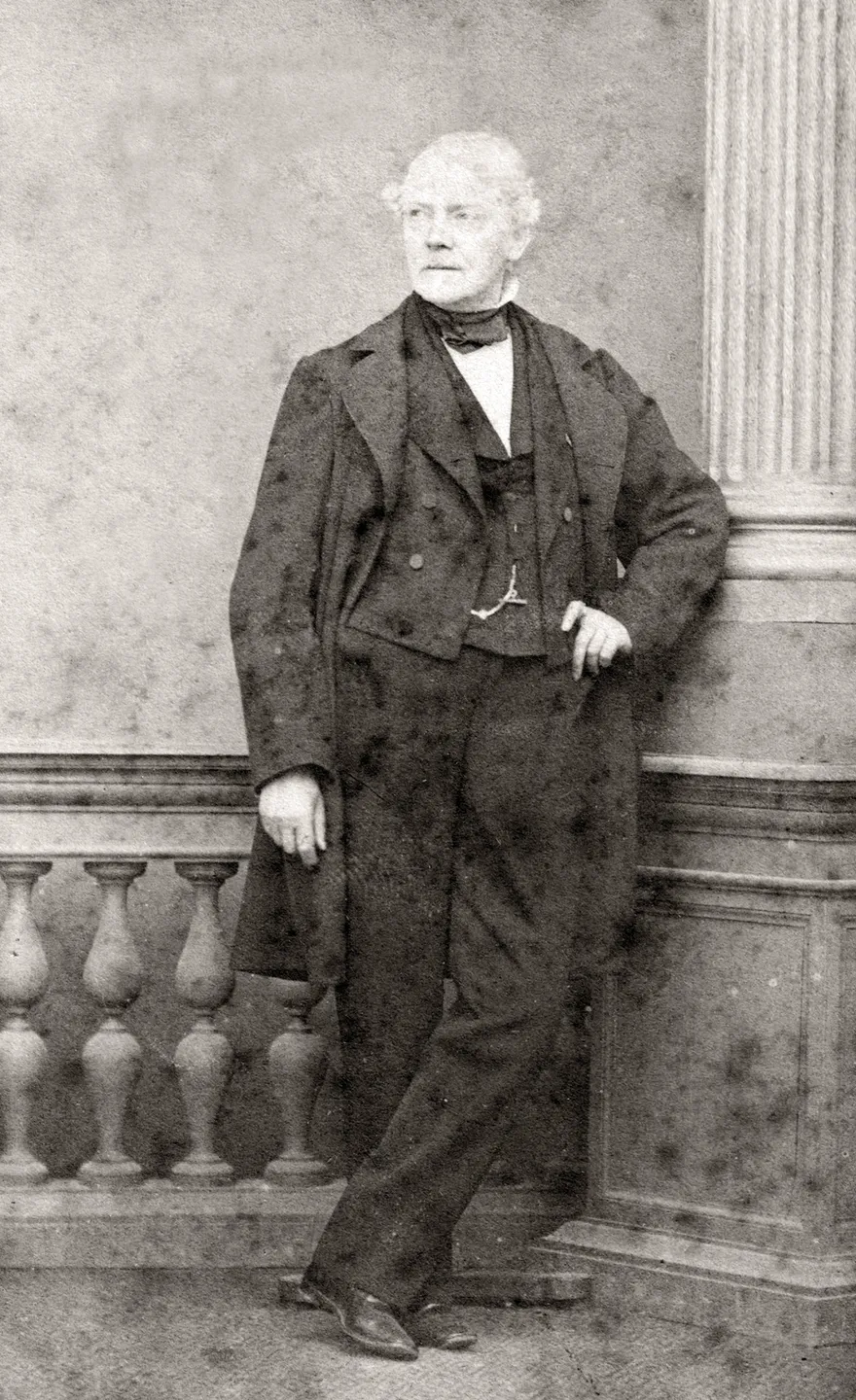
Around this period, a German reviewer making the rounds of Roman studios for the Illustrirtes Familienbuch, published in Trieste by the Austrian Lloyd, climbed the stairs to Brüls's atelier and left the only known physical description of the man. He found a Belgian who had already been in Rome for eighteen years, "still in the most vigorous prime of manhood, though with a head already strongly frosted with grey."
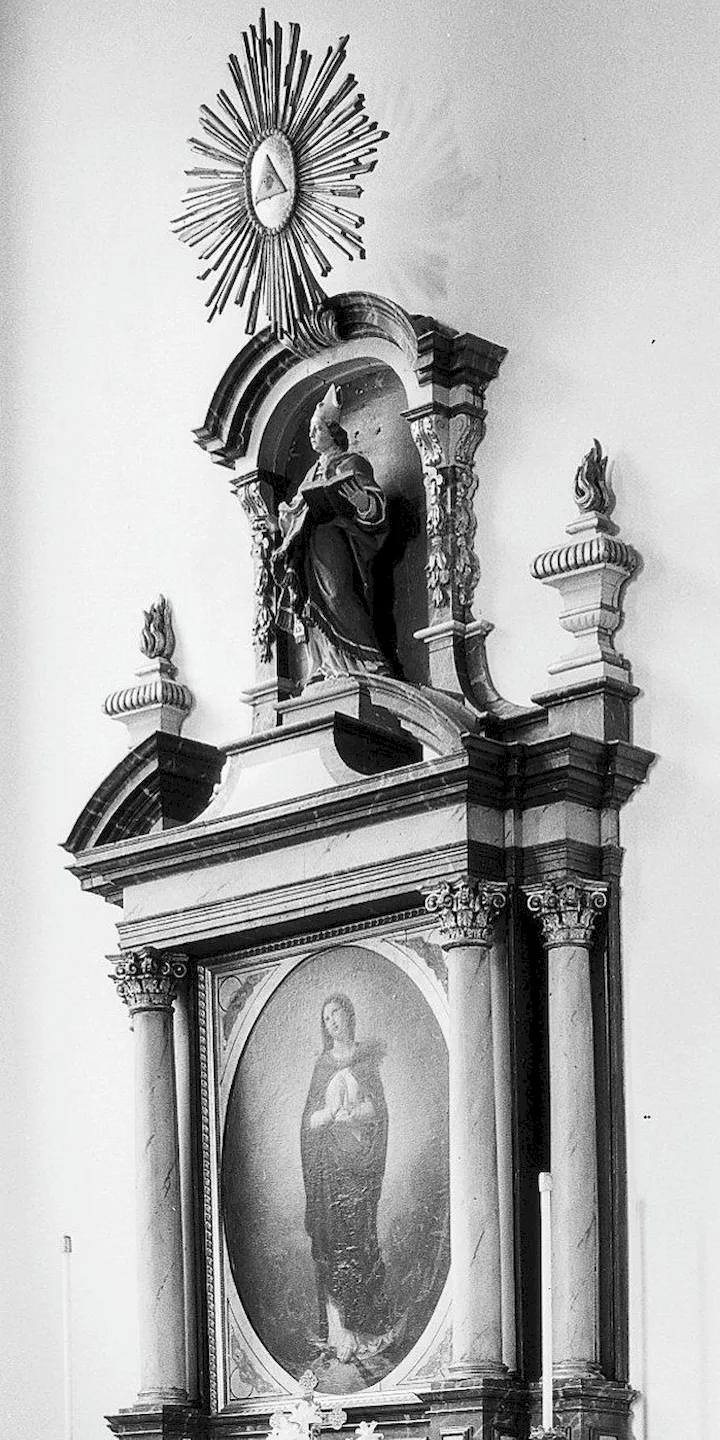
In 1857, Brüls completed an altarpiece of the Immaculate Conception for the same Sint-Lambertuskerk in Kerkrade that had received his Stations of the Cross. The subject was strikingly topical. Three years prior, on 8 December 1854, a formal decree known as Ineffabilis Deus had been issued by Pope Pius IX (1792–1878), declaring the Immaculate Conception to be Church dogma. To paint that very subject so soon afterward was to depict the newest and most prominent doctrine of the reigning pope.
According to a later family account, Pope Pius IX granted an indulgence to the faithful who prayed before the work. Such an indulgence would have required formal recognition at the papal level, implying that the painting had come to the attention of ecclesiastical authorities in Rome.
An Italian press review of 1858 described him as a painter of recognised standing in genre subjects, discussing both devotional and architectural interior scenes and praising his composition and lighting, even while criticising aspects of finish. His activity as a painter continued alongside a growing involvement with antiquities. By the late 1850s, he was collecting and evaluating archaeological material.
In 1858, Brüls was appointed as testamentary executor of the will of Martin von Wagner (1777–1858). Wagner was a painter, sculptor, archaeologist, and art agent who had worked in Rome for over fifty years. The role placed Brüls at the centre of managing Wagner's vast artistic and financial legacy, implying years of close personal trust between the two men.
In 1860, a third commission for Sint-Lambertuskerk in Kerkrade followed: a depiction of Saint Joseph with the Child for the right side altar. Together with the Stations of the Cross and the Immaculate Conception altarpiece, the three commissions formed a coherent programme of devotional imagery aligned with contemporary Catholic practice.
The Roman Acquisition Mission

In 1861, the first acquisition from the Wagner endowment fund was the purchase of Brüls's own personal collection of antiquities for the University of Würzburg.
The collection comprised eighty-two Greek and Etruscan pottery vessels, over eight hundred glass objects, and seventy-five works of early Christian and Byzantine art, along with modern paintings including a Bacchanal by Giovanni Battista Gaulli (1639–1709). That Brüls's collection was chosen as the inaugural acquisition of what would become one of Germany's most significant university museums shows the scale of his activity as a collector.
Between 1861 and 1862, these connections took formal shape when Brüls was engaged as an art agent for the Belgian Royal Museum. Operating in Rome, he acquired paintings on behalf of the Belgian state, including works attributed to Caravaggio and other masters.
The dossier preserved in the Belgian State Archives documented a complete nine-month acquisition mission, with Brüls co-evaluating every purchase as an equal alongside the Belgian diplomat Henri Carolus, under the general direction of Jean Portaels (1818–1895), Director of the Royal Academy of Fine Arts in Brussels.
While acting in this capacity, Brüls also produced a portrait of Cardinal Giacomo Antonelli (1806–1876), the Secretary of State under Pius IX and the most powerful political figure in the Papal States.

As the Pope's chief minister, Antonelli controlled the administrative and diplomatic machinery of the papal government. The existence of such a portrait, now held at the Museum Hof van Busleyden in Mechelen, suggested access and trust at the highest levels of the papal administration.
The role placed him within the structure of Belgian cultural policy abroad and connected him to the diplomatic presence of Belgium in Rome, particularly through the legation to the Holy See. This meant that Brüls operated with recognised authority in the Roman art market, moving between artists, dealers, collectors, and officials.
In late 1862, this role extended into the acquisition of objects from the Campana reserve. The Campana reserve was the remnant of the celebrated antiquities collection of the Roman financier Giovanni Pietro Campana, the bulk of which had already been sold after his collection was seized in the late 1850s.
The purchase consisted of seventy-seven Etruscan and Greek vases, sent to Brussels in three crates by way of Civitavecchia and Marseille. The archaeologist Heinrich Brunn (1822–1894) selected the vases and prepared the catalogue in Italian, while Brüls translated it for the Belgian authorities and helped carry the transaction through. His part was practical and informed, linking Roman sellers, scholarly expertise, and Belgian official interest.
Writing from Rome on 3 December 1862, he explained that after Campana's imprisonment, loyal friends had hidden as many objects as possible and were now trying to sell them. He went to see the cache himself, in the company of a dealer eyeing the same remains, and found several hundred pieces ranging from ordinary wares to vases of, in his words, perfect beauty.
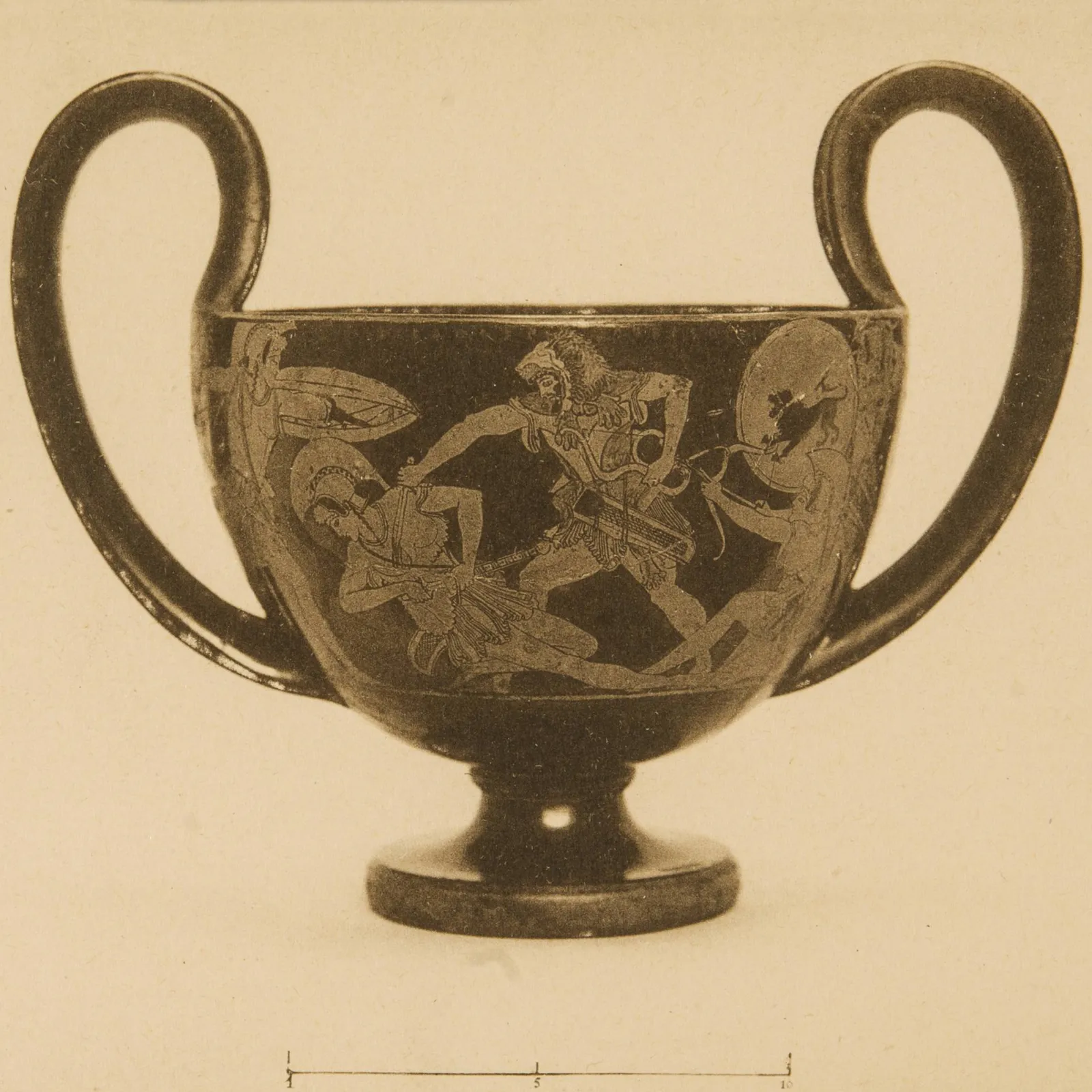
Brüls singled out the Douris kantharos as one of the finest vases he had ever seen. He described it as a vase showing Hercules fighting the Amazons on one side and another Amazon battle on the other.
He also noted that Campana himself wanted to keep the vase. In his letter refusing the dealer's offer, Campana had described it in full detail, down to its inscriptions.
Brüls considered the vase so important that he told the administrators he would abandon the whole plan of recommending the Campana collection to the Belgian government if this piece were removed.
This vase is prominently displayed at the Art & History Museum (MRAH) in Brussels (Inv. A.718).
When the acquisition was publicly celebrated in the Moniteur belge and the Bulletin des Commissions royales d'art et d'archéologie, the credit was given to Brunn alone. Brüls, whose name closely resembled Brunn's, was overlooked entirely. A rectifying note was published in the Moniteur belge on 2 July 1863, but only at the specific request of the diplomat Carolus, and later scholars writing about the acquisition missed the correction.

In 1861, the Società degli Amatori e Cultori delle Belle Arti required papal approval of its newly elected officers, and the political climate made that approval fraught. The Papal States were under direct threat from the newly proclaimed Kingdom of Italy, and the papal court was wary of anyone tied to the unification cause. On 13 November 1861, a memorandum read to Pius IX objected that the election slate included men "di non buon sentore politico," that is, of suspect political reputation, carrying a hint of disloyalty to the papal regime, and on that basis the new officers were refused confirmation.
On 15 December 1862, Brüls's services to the Belgian state were formally recognised by his appointment as Chevalier de l'Ordre de Léopold, Belgium's highest and oldest order of merit.
The Royal Decree identified him as "Brûls (L.), peintre d'histoire, vice-président du comité de l'église de Saint-Julien des Belges, à Rome," that is, history painter and vice-president of the governing committee of the Belgian national church in Rome.
He was the only Chevalier in the decree listed as resident in Rome, and the only one whose title connected him to a foreign institutional role.
In 1863, Brüls was elected to the artistic deputation of the Società, its governing committee. Given the papal vetting of 1861, the election shows that the papal administration had reviewed his name and found no objection.

In 1864 he painted one of the most important works of his career: a portrait of Pope Pius IX, who sat for him in person. The Journal de Bruxelles of 4 June 1864 announced that an artist of rare merit had recently painted a superb portrait achieving a striking likeness, described by those who had seen the Holy Father as "a true mirror of his beautiful soul."
The painting was delivered to the collection of the Comtesse de Meeus, one of Belgium's senior Catholic-aristocratic houses, and the Société royale belge de photographie secured authorisation to publish a photographic reproduction by the photographer Fierlants, with the subscription list headed by the King of Belgium.
The Pope was depicted holding the bull of the Immaculate Conception. The choice of subject linked the portrait directly to Brüls's earlier altarpiece of the same subject at Kerkrade, suggesting continuity between his ecclesiastical commissions of the 1850s and his later work for the papal court.
The Antonelli portrait, the papal vetting of the Società elections, and the Pius IX portrait place Brüls within the inner circle of the papal court during these years. Louis was connected to the highest ecclesiastical and political authorities of the Papal States.
From Rome to Rochester
In 1866, the Belgian church in Rome, San Giuliano dei Fiamminghi, was restored. To mark the work, the community put up a stone plaque naming the six men who had overseen and paid for it. Louis Brüls was one of them, listed with his honorary title, Knight of the Order of Leopold.
The engraving reads: LVDOVICVS BRVLS EQVES LEOPOLDIANVS
The other five were all prominent men: the Belgian Ambassador to the Pope, an Archbishop, two senior figures from the papal court (a chamberlain and a protonotary), and the Belgian Consul. Brüls was the odd one out. He was the only one of the six who was not a diplomat, a clergyman, or a government official. He was included for a simpler reason: he was a well-known artist and a respected member of the Belgian community in Rome.
The plaque was later copied down by the historian Vincenzo Forcella in his survey of inscriptions in Rome's churches, which is how we know about it today.

He continued to exhibit in Rome, including a final documented participation in 1864 at the Società degli Amatori e Cultori delle Belle Arti with the work Fabiola, reflecting contemporary Catholic themes.
His output during the 1860s also included works that entered public collections, such as Fanciullo addormentato e cane (Sleeping Child and Dog), signed "L. Bruls / Roma 1865," now in the Museo Colocci in Jesi.
In 1864, a letter published in the Giornale Arcadico quoted him as an authority on a Van Eyck tapestry, with the editors identifying him as "il sig. cavaliere Luigi Brüls" and citing him as a qualified expert witness on Flemish old masters. In 1867, he wrote to Johann Jakob Bachofen regarding Etruscan antiquities he was attempting to obtain. The letters showed him acting as both painter and connoisseur within the European antiquities world.

His work also reached the United States, though under garbled versions of his name that created separate, mistaken identities in American records. A painting called Innocence and Fidelity was lent by the New York collector G. A. Conover to the Great Central Fair in Philadelphia in June 1864, a wartime charity exhibition to raise funds for the U.S. Sanitary Commission during the Civil War.
The catalogue listed the artist as "L. Bruls." The painting later entered the collection of Daniel W. Powers (1818–1897), a Rochester banker who assembled one of the most significant private galleries in upstate New York.
In the Powers catalogue of 1877, the artist's name had mutated into "Ludovico Brunts" and his nationality was recorded as Italian.
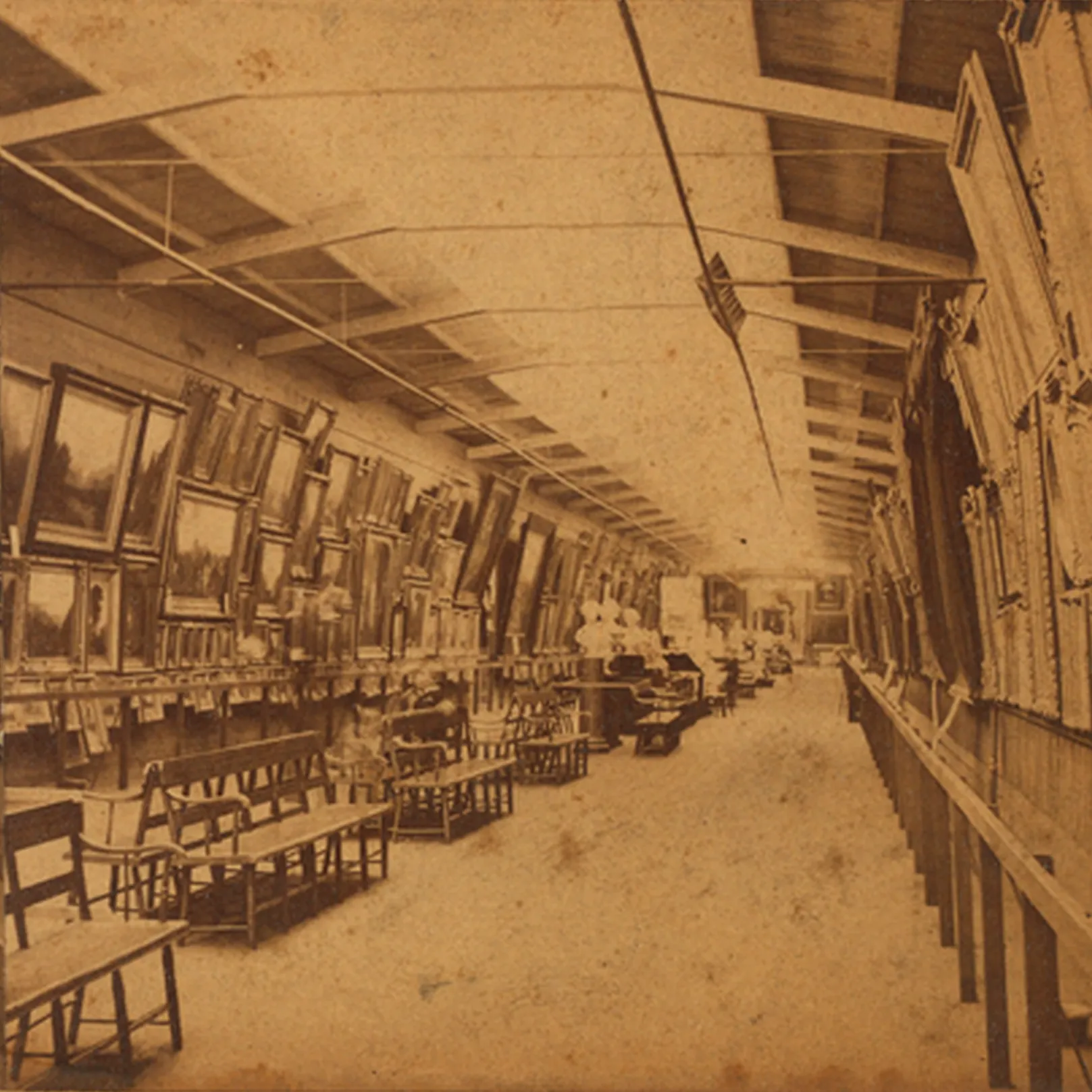
A second Brüls painting, Mother and Child in a Storm, also entered the Powers collection. Both were catalogued again in a catalogue from 1897, still under the name "Brunts," and both had disappeared from the collection before an estate sale at Chickering Hall, New York, in January 1899. Their present whereabouts are unknown.
A third painting, exhibited at the Boston Art Club in January 1876 under the title Charity and the correct name "L. Brüls," was owned by Abraham Orlando Bigelow (1812–1887).
Two Boston critics reviewed it within a week of each other. The Commonwealth described a graceful lady in regal costume dispensing charity to "two poor old creatures who look up to her as to a goddess," praising the beauty and sentiment of the picture but adding that "it is not altogether agreeable to American eyes in the suggestions of rank, and the abject condition of the lower orders."

After Bigelow's death in 1887, the painting passed through the hands of the Boston philanthropist Caroline L. W. French, who gave it to the Boston Athenaeum in 1915, where it remains today under the title Woman with Two Children.
The name confusion was not a posthumous accident. It had already taken hold while Brüls was alive. By 1877, when he was still working in his studio in Rome, a gallery in Rochester had catalogued him as "Brunts," and as an Italian. The name was wrong and so was the nationality, printed an ocean away where he had no way to know of the errors, let alone correct them.
After his death the problem only got worse. The Smithsonian's Pre-1877 Art Exhibition Catalogue Index, drawing on those earlier catalogues, split him into two separate artists, one filed as "Bruls, L." and the other as "Brunts, Ludovico." Auction houses turned the Belgian into a German, and dealers retitled canvases they could no longer place. By the time anyone thought to trace the works back, the link between Louis Brüls and his own name had all but broken.
This helps explain why an artist whose paintings reached Philadelphia, Rochester, Boston, Munich, Brussels, Mechelen, and Jesi never built the steady reputation those appearances might have earned him.

In 1870, Rome fell to the Kingdom of Italy. The end of the Papal States transformed the context in which Brüls had lived for decades, though he remained in the city.
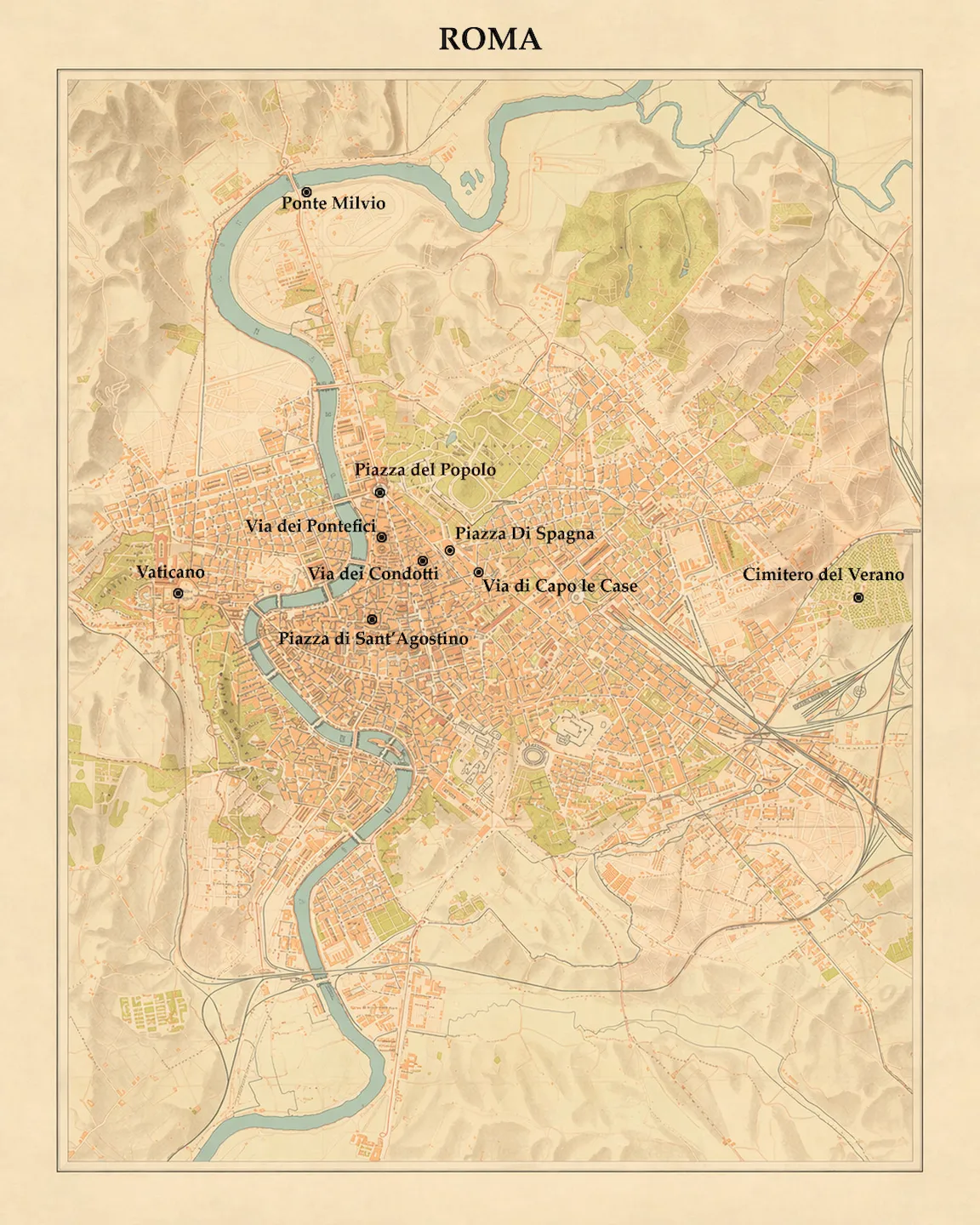
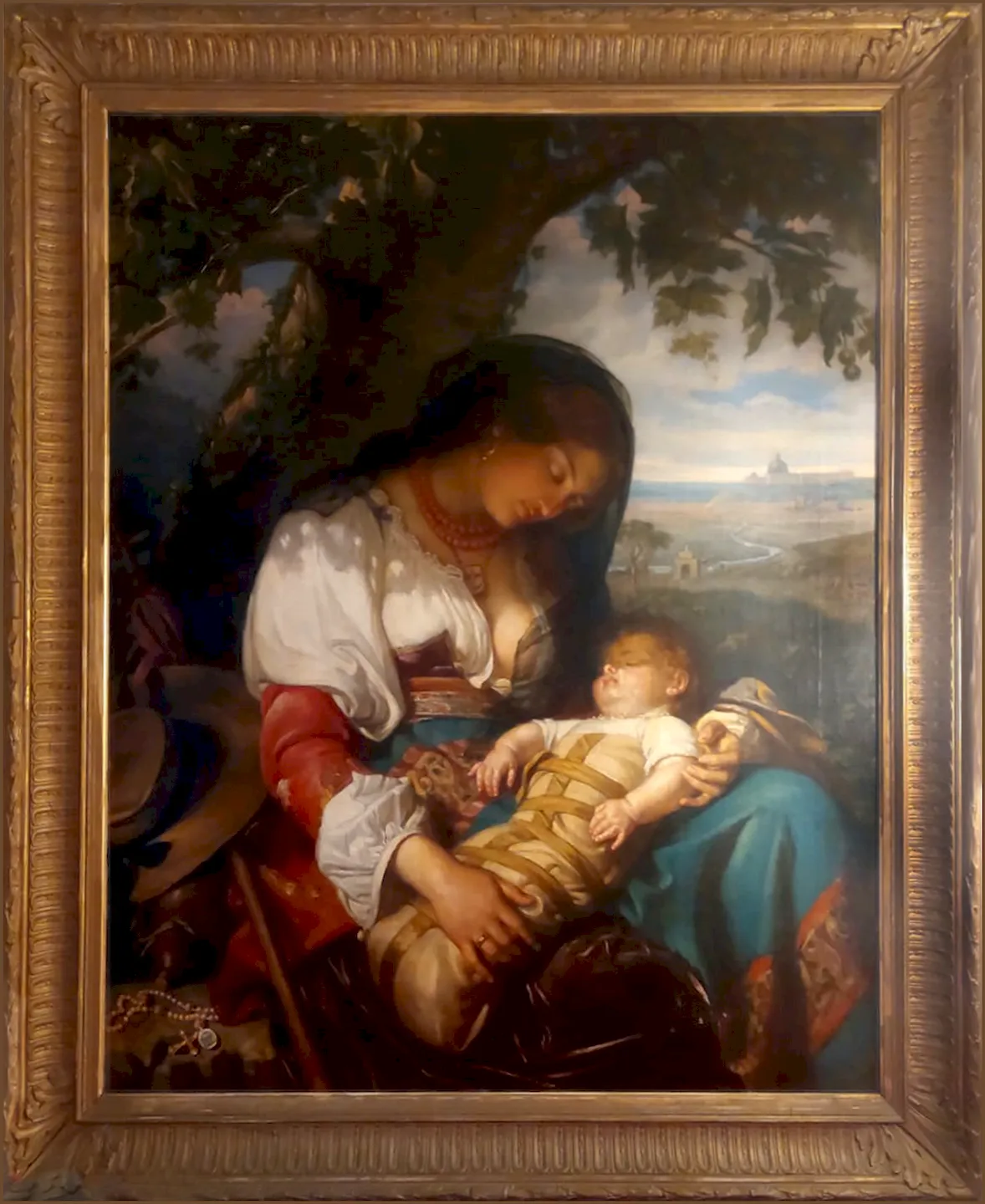
A painting from 1870 offered something more personal. La pélerine du Ponte Molle was recorded in later notes by Léon Hucklenbroich, with the suggestion that the artist's wife had served as model. The composition showed a seated woman holding a baby, set within a landscape near the Ponte Molle (now Ponte Milvio), and had a distinctly intimate character, closer to a secularised Madonna and Child than to a formal religious scene.
No independent record of Brüls's marriage has yet been identified, but family sources named his wife as Maria Micocci and described her as one of his models. The couple may have had a daughter, said by family tradition to have been born around 1869, but her identity and fate remain uncertain. He continued to paint and to act as intermediary into the 1870s.
The Last Decade
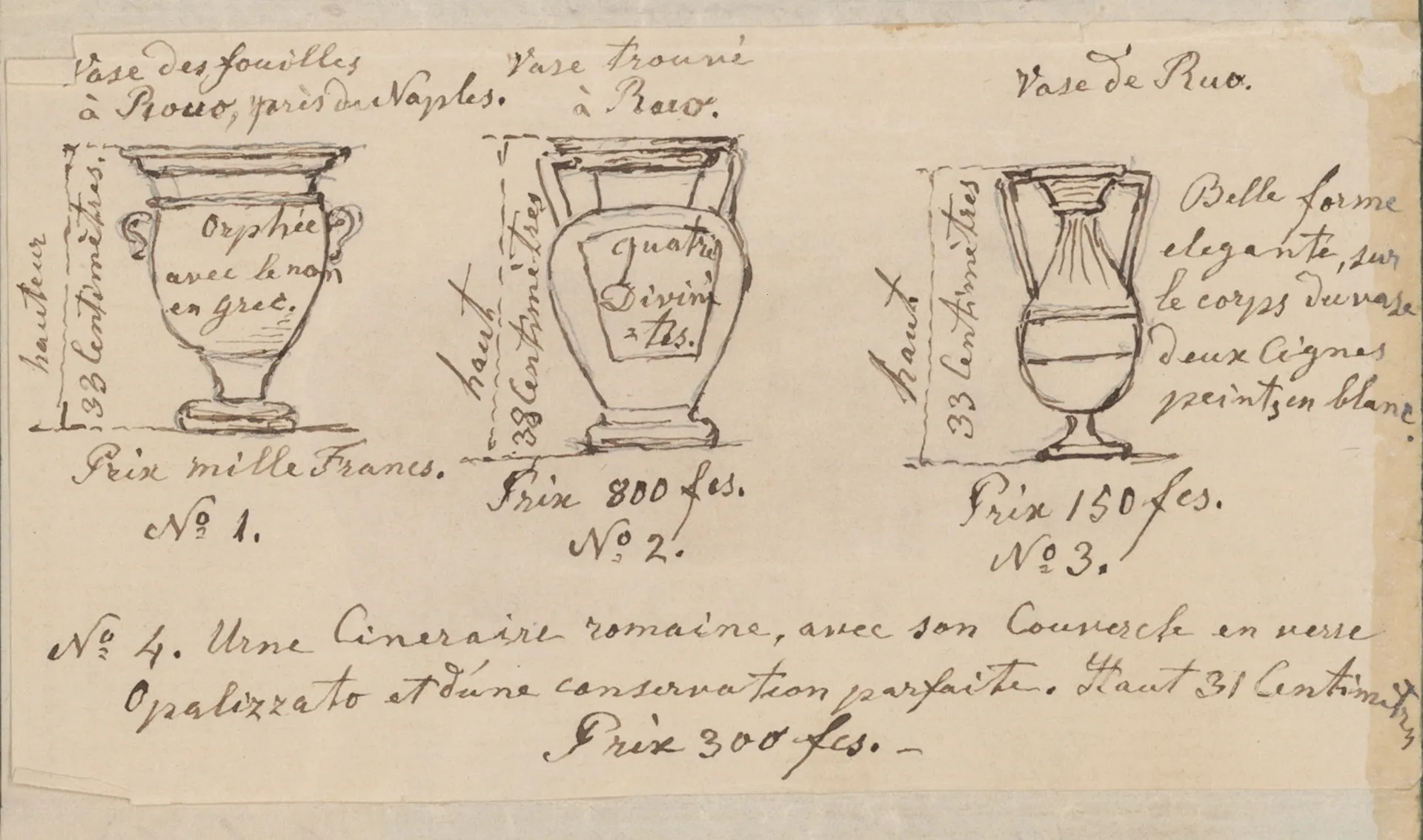
In 1873 and 1874, Brüls acted as a private buyer in Rome for the Basel collector Johann Jakob Bachofen, sourcing and shipping antiquities to him directly. One consignment in early 1874 held twenty Etruscan vases and thirty-four terracotta lamps, packed under his supervision and sent by rail to Civitavecchia, by steamer to Marseille, and on to Basel.
The surviving letters show every stage of the work in his own hand. He walked the dealers' shops, drew each vase to scale with its place of origin and price, negotiated with sellers such as Celli and Capobianchi, obtained the export permit and customs seal through the forwarding agent Fulvio Caldani, and settled payment through a Basel bank. He was buyer, connoisseur, and shipping clerk at once. He no longer kept a collection of his own by this point, having sold it the year before, but he remained the person others trusted to find the right objects and get them shipped safely north.
He was still at it six years later. A letter of 29 March 1880 finds him, at seventy-six, back in the Roman shops for Bachofen, proposing seven specific pieces from the dealer de Poletti, sketching the vases on a separate sheet, and noting a collection of a thousand pagan and Christian lamps, on sale for 35,000 francs, that he thought a national museum ought to acquire.
One of his last known paintings, Der Abschied (1881), was made in Rome; no exhibition of it is recorded.
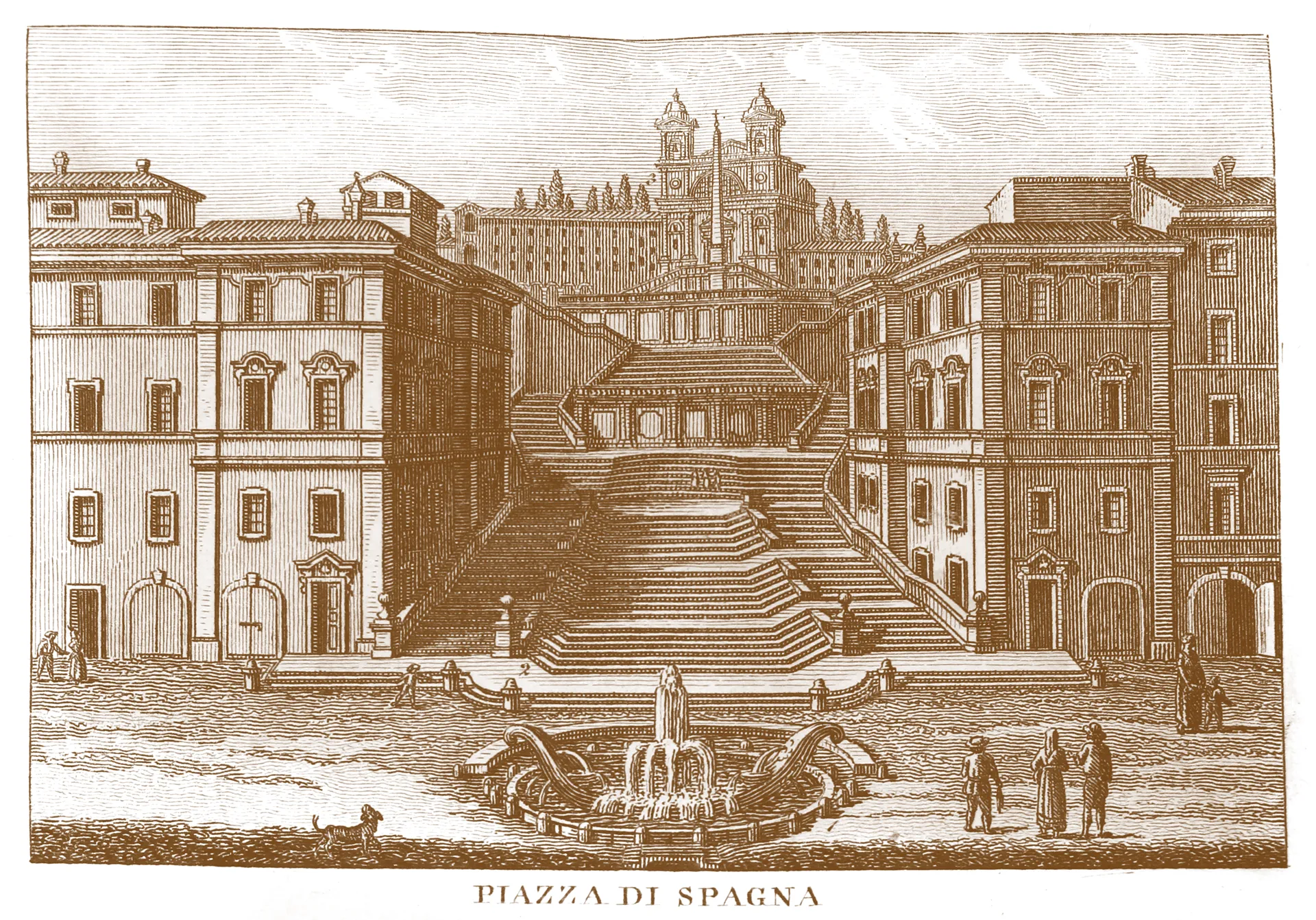
Louis Brüls died in Rome on 19 December 1882, aged seventy-nine, in the quarter near the Spanish Steps where he had lived and worked for more than forty years. He was buried in the Campo Verano, in the chapel of the Arciconfraternita del Preziosissimo Sangue, beneath a stone placed by his widow.

The marble tomb bore sculpted profile medallions of both husband and wife, with an inscription in Italian and French identifying him as Cavaliere Lodovico Brüls, born in Brussels on 15 April 1803, though family tradition, supported by other documentary evidence, insisted his birthplace was Drinhausen near Übach. The monument was placed by his "sconsolata moglie," his inconsolable wife, who expressed the hope of being reunited with him.
He had lived in Rome for more than forty years. In that time he had painted for popes and parish priests, acquired antiquities for German and Swiss scholars, served the Belgian state as buyer and translator, and held office in the church of his compatriots. His paintings hung in Munich, Brussels, Mechelen, Boston, and Jesi, yet no single institution or national tradition claimed him as its own. His name was already appearing in unstable forms: Brüls, Bruls, Brûls, Brunts, sometimes Belgian, sometimes German, sometimes Italian. The work of recovering him would fall to his family, and it would take generations.
