Early Life
Gut Drinhausen
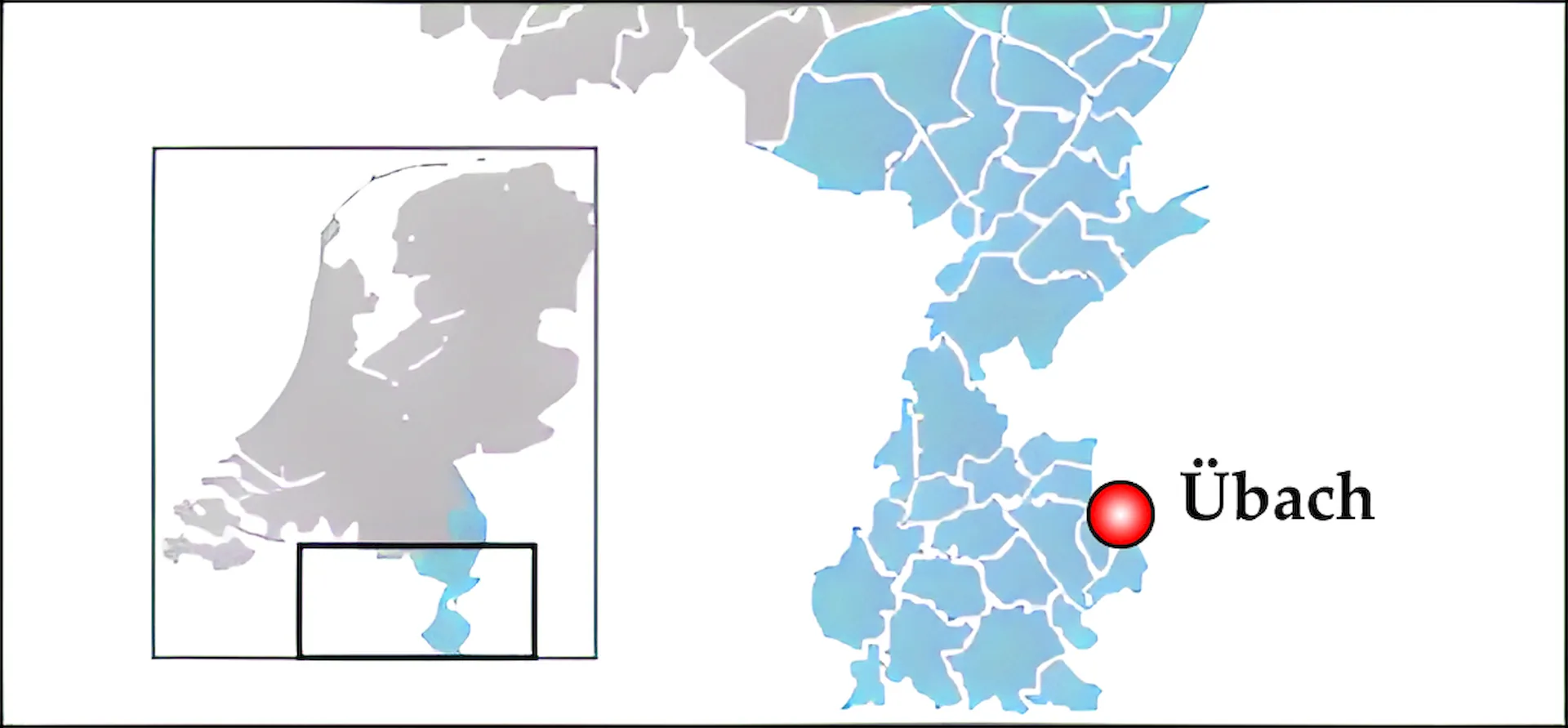

Ludovicus Josephus Brüls was born on 15 April 1803 at Gut Drinhausen (Goed Drinhausen), a manor farmstead near the village of Übach (now Übach-Palenberg, North Rhine-Westphalia, Germany).
The manor lies approximately 17 km north of Aachen, on what is now the Dutch–German border, close to Belgian territory. At the time of Louis's birth, Übach was French territory, part of the Département de la Roer under Napoleon's rule.
Family memory, recorded by Marie-Louise Hucklenbroich in the twentieth century, described Drinhausen as a large farm whose own lands surrounded it on every side, leaving it isolated, and approached by a long avenue of imposing oak trees.
Gut Drinhausen belonged to the Abbey of Thorn (Abdij van Thorn), a noble convent of canonesses founded around 975 with extensive holdings across the Meuse region. The estate first appears as abbey property in a charter of 1235–36, which records the abbey granting the hof van Drinhuizen as a life tenancy. For more than six centuries the abbey held manorial lordship over Übach and leased the estate to resident tenant farmers (villici), retaining title throughout. This arrangement ended only with the French Revolution, when the abbey was dissolved and its lands sold off in 1798.
The Brüls and Peltzer Families


Louis's parents, Peter Josef Brüls (1758–1833) and Maria Christina Peltzer (1770–1836), are recorded in civil records as Grondeigenaar and Grondeigenares, the Dutch terms for landowner, a designation reflecting civic standing in this period. Peter Josef was no mere farmer: he had served as Schepen (alderman) of the bench of Übach as early as 1783, and as municipal secretary by 1794.
Between 1797 and 1800, he was the most frequently recorded party in the local notarial repertoire, handling sales, mortgages, and property transactions across the commune.
The Peltzer family, Louis's maternal line, had served as villici at Drinhausen across at least three generations, acting as resident estate managers of land historically leased from Thorn Abbey.
The Brüls family acquired full legal ownership of the estate on 2 March 1798, when Peter Josef purchased the confiscated Thorn Abbey property at public auction. The sale record describes the holding as a house called Drynhuysen with approximately 65 bonniers of land, roughly 50 to 65 hectares of agricultural ground.
Louis was the family's seventh child, and the sixth surviving at birth. He was born into a household that combined long-standing tenant management with newly acquired ownership of the same property, completing a generational ascent from service to proprietorship. This continuity of status at Gut Drinhausen helps explain the family's regional prominence and the resources available for his later education and artistic training.
Louis's childhood was shadowed by loss. Two of his brothers, Joannes Petrus Brüls (1798–1811) and Henricus Josephus Brüls (1801–1811), both died in 1811, when Louis was eight years old. The wider world, too, was in upheaval: after Napoleon's defeat, the Congress of Vienna redrew the map of Europe, and the left bank of the Rhine, including Übach, was assigned to the Kingdom of Prussia.
The Athénée de Maastricht

In 1818, when Louis was fifteen, he was enrolled as a boarding pupil at the Athénée de Maastricht, living at the school rather than commuting from Übach, some 25–30 km away.
A prize ceremony for scholastic achievement took place on 20 August 1818 in the Town Hall of Maastricht, presided over by Burgomaster Van Slype. The governor, judges, clergy, and military officials attended alongside a large public audience, making it a major civic event rather than a routine school function.
Louis's peer group at the Athénée included students who would go on to considerable distinction. Louis Brüls won second prize in the Sixth Class for Latin translation and theme (Version et thème). He was beaten for first place by André Van Hasselt, who later became one of the most prominent Belgian poets and literary scholars of the nineteenth century. Another prize-winner in the same class, Théodore Weustenraad, also went on to become a recognised Belgian poet.
The class regent was his elder brother Jean-Joseph Brüls (1791–1864), who held a teaching post at the Athénée and later became a professor there. This made the 1818 prize-giving a notable family moment: Louis receiving an academic distinction in a class taught by his own brother. Louis also placed second in the first (higher) division of the drawing class, behind the prize-winner Louis De Villers. This is the earliest documented evidence of his artistic ability: a formal academic prize for draughtsmanship. Louis likely completed his secondary education at the Athénée de Maastricht by around 1819–1820.
A few years earlier, King Willem I of the United Kingdom of the Netherlands had granted the Antwerp Academy of Fine Arts royal status. Under the direction of Willem Jacob Herreyns (1743–1827), it was recognised as the leading art school in the Southern Netherlands. At seventeen, Louis left Maastricht for Antwerp to pursue his training at the Academy. His years as a schoolboy were behind him; his life as an artist was about to begin.